
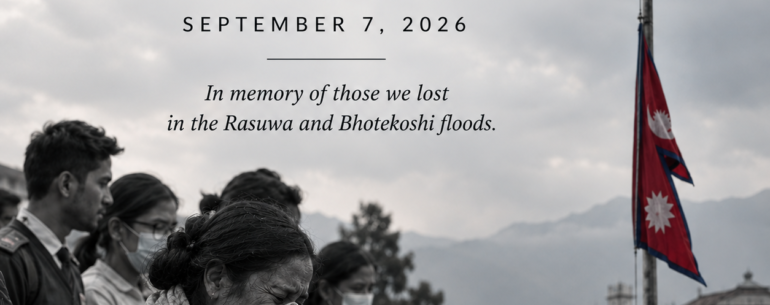

After a catastrophic flood tore through the Bhote Koshi–Trishuli corridor, Nepal is moving from an emergency dominated by search and rescue towards the much longer work of recovery. The scale of the disaster is still being assessed, and the numbers continue to change as bodies are recovered, missing people are located and damage assessments reach areas that remain difficult to access.
The Toll
According to the latest government-linked assessment, 1,370 people have been confirmed dead and 5,130 remain unaccounted for. Around 1.6 million people have been affected, with Rasuwa and Nuwakot among the worst-hit districts and extensive damage recorded downstream in Dhading, Gorkha and Chitwan.
The human loss has been accompanied by a huge displacement and recovery challenge. Thousands of homes have been damaged, communities have lost roads, bridges, schools and health facilities, and many families are still waiting for news of people who remain missing.
What Happened
The disaster began on 26 August in the Lhende Khola basin near the Nepal–China border. Current reporting indicates that a large section of glacier and bedrock collapsed into the basin, temporarily blocking the river before the barrier failed and released a destructive surge of water, ice, rock and debris downstream. The flood then travelled through the Bhote Koshi and Trishuli river systems, devastating settlements and infrastructure along the corridor.
Rasuwa was struck first, with places including Timure and Syabrubesi suffering major damage. The surge continued downstream through Nuwakot, Dhading and other districts, with bodies and debris subsequently recovered much farther along the river system.
Infrastructure
The physical damage is enormous.
The latest rapid damage assessment estimates that 69 kilometres of roads were damaged and 33 motorable bridges were washed away, with another four suffering partial damage. Of 64 footbridges assessed in the affected areas, 53 were damaged. (Source: The Kathmandu Post)
The energy sector has also been badly hit. Thirteen hydropower projects and five solar plants were affected, alongside substations and transmission infrastructure. The government now estimates that Nepal will require around NPR 723.31 billion for reconstruction and recovery from the disaster, with roughly three-quarters of that requirement tied to infrastructure. (Source: The Kathmandu Post)
The Rasuwagadhi–Kerung crossing remains disrupted, and damaged roads continue to make access to parts of Rasuwa difficult. In some remote areas, relief and supplies are still being moved by helicopter. The government says road clearance and temporary bridge construction are continuing. (Source: Ministry of Foreign Affairs)
The Response
The response has moved well beyond the first hours of rescue, but search operations are still active.
Nepal’s Army, Police and Armed Police Force remain fully mobilised. Tunnel rescue teams from India, China and the Republic of Korea are working alongside Nepali forces, while teams and technical assistance have also come from the United Arab Emirates, Malaysia and Australia. International forensic teams from India, China, Japan, Singapore and South Korea are assisting with DNA collection and identification. (Source: Ministry of Foreign Affairs)
The challenge now is increasingly one of access, identification and recovery. Some communities remain difficult to reach, while thousands of families continue to wait for confirmation about missing relatives.
What This Means for Travellers
It is important to distinguish the affected corridor from Nepal as a whole.
The August flood did not affect the country’s major trekking regions uniformly. The Nepal Mountaineering Association has confirmed that destinations including Everest, Annapurna, Manaslu and other major mountain regions remain operational, although access conditions should always be checked before departure. (Source: Tourism Times)
There is one important qualification: Manaslu experienced a separate flood on 6 September near Namrung. The route reopened on 9 September after an alternative trail and temporary bridge were established, but conditions there are not yet entirely back to normal, and the temporary bridge currently has restrictions on pack animals. (Source: Explore All About Nepal)
Langtang and Gosaikunda are different. The trekking areas themselves have not been uniformly destroyed, but the principal access corridor through Rasuwa has been severely damaged. The road towards Dhunche and Syabrubesi remains disrupted, so anyone planning Langtang, Gosaikunda or other Rasuwa-area journeys should check the latest local conditions rather than assuming normal access. (Source: Tourism Times)
For travellers already planning Nepal, the sensible approach is therefore simple: check the specific route, check its access, and speak to your trekking operator before departure.
What We’re Doing
At Cold Feet, the work has moved from immediate relief towards what comes next.
Through Warm Hands, the relief initiative of the Cold Feet Foundation, our team has delivered a second round of supplies into the Trishuli basin, including rice, lentils, salt and household essentials for families staying at a holding centre.
The next phase is being prepared now, with quilts, bedding, bed covers and pillows among the priorities as temperatures begin to fall.
This is the less visible part of a disaster. Once the water recedes and the cameras move elsewhere, people still need somewhere warm to sleep, food to cook, schools to reopen and roads to reconnect them with the rest of the country.
The water is gone. The work isn’t.
If you’re able to support this next phase, you can do so through the Warm Hands Foundation.
We will continue to update this page as verified information becomes available.
Figures and conditions in this article are provisional and may change as search, identification, damage assessment and recovery work continue.
Leave a Reply
You must be logged in to post a comment.