
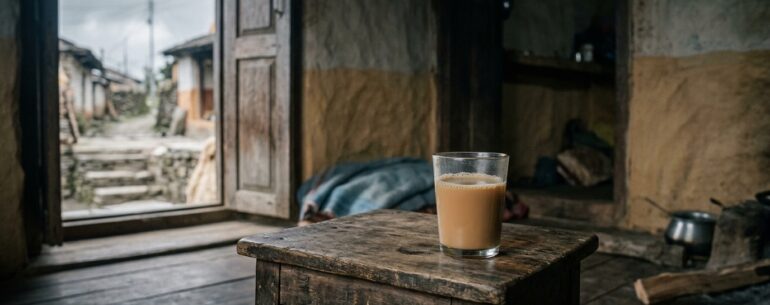

There is a version of that Wednesday that no one photographed, because no one thought to. In Timure, a border town that exists because the road to Tibet has to pass through somewhere, a shopkeeper lifted the same shutter he had lifted every working morning of his life. In Syabrubesi, where the highway from Kathmandu ends and the trail to Langtang begins, a lodge owner put a pot on to boil for trekkers who had come down off the mountain the evening before.
At a hydropower project on the Trishuli, a twenty-four-year-old man named Sujan Nepali finished a night shift and went to sleep in the workers’ dormitory, the way he had after every night shift before this one. At another project nearby, a man named Jiblal Adhikari had breakfast and walked into the underground powerhouse a little after seven, the way he did most mornings. He and his wife usually checked in with each other online at a set hour — a small, unremarkable habit of a marriage, the kind of thing that never once seemed worth mentioning until it stopped happening.
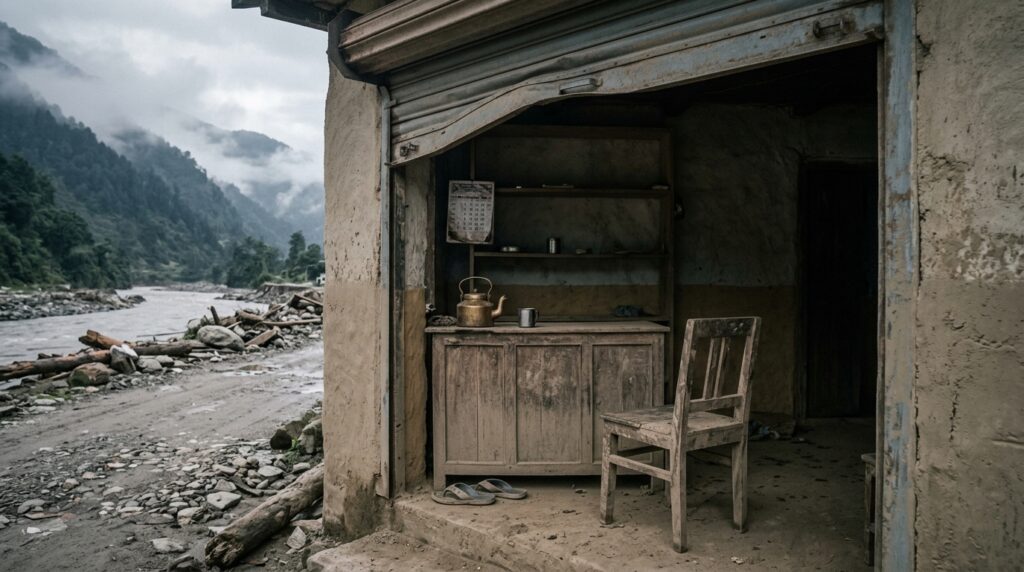
There had been no rain. That detail will be repeated for days afterward, almost in disbelief — no rain, nothing in the sky to explain what was already moving toward them.
By nine in the morning, the water was in Nepal.
None of them had known they were living inside their last ordinary morning. The shutter, the pot, the night shift, the walk into the powerhouse at seven — nobody experiences these as beliefs. They don’t feel like something being trusted. They feel like the ground.
Somewhere upstream, in the mountains on the far side of a border most of them had never crossed, something in the ice had already let go.
The news, in the days that follow, speaks in the vocabulary disasters are always described in. Houses gone. Roads gone. A district cut off from the districts around it. Hydropower plants that had fed the national grid for a decade reduced in an afternoon to flooded tunnels and buried powerhouses. Close to nine hundred people connected to those hydropower projects along the Trishuli were still unaccounted for days later — many of them low-paid laborers, some who had come from India for the work.
These figures are true, and they establish scale. But scale is not where a life is kept. A life is kept in the particular arrangement of a particular room, the ledger of small debts written in a hand no one else can read, the ten seconds it takes to know, without looking, where the matches are. None of that survives translation into a casualty count. A house is a statistic until it is your house.
Some kinds of wealth never appear on a balance sheet, and rarely get named until they’re gone: knowing where the keys are. Knowing who will be at the tea shop at a given hour. Knowing what the river sounds like on an ordinary night, so that you’d notice immediately if it sounded like something else. Knowing, without having to check, that the road you took yesterday will still be there today. This is not sentimentality. It is infrastructure — the invisible scaffolding that lets a person move through a day without having to re-verify the world at every step. A flood does not simply destroy roads and houses. It destroys the reliability that let people stop thinking about roads and houses at all. What replaces it is a kind of low, permanent vigilance: a body that now listens to rain instead of hearing it.
Sujan Nepali’s sister, Sushisha Maluwar, has spent the days since the flood doing something almost unbearably ordinary: going, every day, to the trauma center in Kathmandu, and checking whether her brother’s name has appeared on a list. According to reporting by the Guardian’s Ahmer Khan, who visited the hospital in the days after the disaster, families like hers have been pinning photographs of the missing to the hospital’s walls — a one-year-old’s picture glued up by an uncle still searching for an entire village that had disappeared; a poster of a husband, a driver who crossed the Nepal-Tibet border for work, whose phone went silent after a morning walk and has not turned back on since. Maluwar keeps writing her brother’s name down at every hospital she can reach, on the chance that it might turn up attached to someone still breathing. “We haven’t lost hope,” she told the paper. She does not yet know whether to speak about her brother in the present tense or the past one, and there is no ceremony, no form, no authority that can tell her which is correct. That decision belongs entirely to her, and it will not resolve itself on any schedule she controls.
This is the difference between death and missingness that grief has no real vocabulary for. Death closes a door, however terribly. Missingness leaves it open a crack that never quite shuts, and a family can spend months, sometimes years, standing in that gap — unable to fully mourn, because mourning assumes an ending, and unable to fully hope, because hope gets thinner with each day the list doesn’t include the name they’re looking for. One woman told the Guardian she was now hoping only that a body could be found, because a body, unlike an absence, could finally be grieved.
Underneath all of this runs a smaller, quieter collapse: the one from my to theirs. My house becomes wherever they have put us. My shop becomes a stall on borrowed ground, if it exists at all. My routine becomes a schedule someone else decides. People who spent their whole adult lives providing for themselves now stand in lines, fill out forms, wait to be assigned a tarp and a place to sleep. None of this is a failure of character — it is what disaster does to self-sufficiency, almost immediately, and it rarely makes the news, because dependence does not photograph as dramatically as a collapsed bridge.
Anger sits underneath this too, and it is not abstract. By the fifth day, families who had been camping outside the Nepal Electricity Authority’s headquarters in Kathmandu and the army barracks in Nuwakot, waiting for word from the hydropower tunnels, were no longer hiding their frustration with how slowly the search was moving. “Every second counts for us,” one man, Jiban Khadka, said of a relative still unaccounted for inside a plant — a plain sentence, but there was real anger underneath its plainness, the anger of watching a rescue take longer than it seemed like it should, while the people you love are the ones running out of time. It is not the same as anger at the river. The river never claimed to be careful. People did.
And beneath the anger, guilt that makes no logical sense and does its damage anyway — the guilt of having left five minutes earlier than someone else, of having taken the day shift instead of the night one, of being the sibling who happened to be in Kathmandu instead of Rasuwa. None of this is rational. Grief rarely consults reason before it moves in.
A category of loss becomes visible only afterward, because nothing about it was ever solid enough to photograph. Before the water came, someone was three years into paying off a loan for a shop that had just begun, finally, to turn a small profit. A family had already chosen where a new house would go once the youngest child finished school. Somewhere on the trail above Syabrubesi, a trekker who had planned six more days in the mountains never got past this one morning. None of these were extraordinary plans. They were the ordinary machinery of ordinary hope, and the flood did not interrupt them so much as remove the ground they were standing on.
People do not only mourn what they had. They mourn what they had assumed they would still have — that a season leads to the next one, that effort accumulates into a future instead of simply washing away. A disaster does not just take. It also invalidates every quiet prediction a person had been making about their own life without ever noticing they were making it.
Physical places normally do something we rarely think to be grateful for: they confirm our memories. This is where my father stood. This is the tree. This is the shop. The place corroborates the memory, so the memory never has to stand alone. After a flood, some of those places are simply gone, and something strange happens to what’s left. Memory stops being a way of visiting the past and becomes, instead, the only remaining evidence that the past was real. You remember the courtyard. The courtyard is gone. At a certain point, the person doing the remembering is the last witness left, and the past becomes something closer to an unverifiable claim — a country that no longer has a physical address, that can be described but no longer visited, no longer checked against.
Nobody photographs the third cup of tea on an ordinary Tuesday, or the sound of a familiar cough from the next room, or a mother calling someone in for dinner. These moments were never considered worth preserving, precisely because there was no reason to think they were finite. Then, for some families, they turn out to have been finite all along, and the unphotographed becomes the only thing anyone would give almost anything to have back.
Somewhere in the middle of all this comes a stage that is not quite denial, though it borrows denial’s grammar. Perhaps the shop will still be there, only muddy, only needing to be cleaned out. Perhaps the name will finally appear on a list, attached to someone still breathing. It is not a rational hope, and most people holding it know that. Grief does not organize itself by what is rational. It organizes itself by what is bearable, and for a while, the idea of an undoing is more bearable than the fact of a loss.
Then a real morning comes, the kind that cannot be negotiated with. The confirmed dead climbed past the first handful, past the first dozens, and kept climbing through the days after, past any figure that felt safe to call final. Meanwhile, outside Rasuwa, the ordinary machinery of the country continued running almost immediately — the news cycle moving toward whatever came next, donations arriving and being logged, reconstruction estimates published in newspapers most of the affected families will never read. Public time and private time do not run at the same speed. A disaster can last fifteen minutes and take a decade to finish happening to the people inside it. For a family still checking a hospital wall every morning, the flood is not history. It is still Wednesday.
For everyone touched by it, a line now runs through their biography that was not there a week ago. Everything before the twenty-sixth of August belongs to a version of the world that no longer quite exists — not because that world was destroyed everywhere, but because the people who lived through this particular morning can no longer stand inside their own lives the way they once did, even in the places the water never reached. A date becomes a border. On one side of it, a woman had a husband who checked in with her online most days, at a set hour, out of habit. On the other side, she is still waiting for a check-in that was never going to come, and did not know it yet.
Some things will not come back at all. Some of the missing will remain missing, and their families will be granted no ending — only a permanent, open middle they will carry for the rest of their lives. No one should be asked to turn this into a lesson. There is no version of it that improves a person, no arc bending toward growth anyone would have chosen if given the choice not to grow this way. When resilience appears — and it will, because people continue — it will not be proof that the tragedy had a purpose. It will simply be a shopkeeper standing again behind a shelf he had to rebuild, because the alternative was not rebuilding it, and he still had to live somewhere inside the days that kept arriving whether he wanted them or not.
And life does not become solemn just because tragedy happened to it. Even now, people worry about money, because the loan does not pause for a flood. They ask when the road will reopen, because there is a harvest, or a job, or a hospital visit that cannot simply wait for grief to finish. Someone catches themselves laughing at something small — a child’s joke, a stranger’s dry comment while queuing for rice — and looks briefly ashamed of it, as if laughing were a kind of disloyalty. It isn’t. It is just what a body does, being alive. Grief does not get a clean stage to itself. It has to share the day with dinner, with a leaking roof, with a phone that needs charging, with all the small, stupid, necessary business of continuing.
Morning keeps coming, along the Bhote Koshi as everywhere else. The people who lost the most do not get released from time. They wake, and for a moment they do not remember, and then they do, and then they have to decide — not grandly, just by getting up, by walking somewhere, by writing a name down at one more hospital — to keep being alive inside a world that has already shown them it was never guaranteed to hold still.
Morning, indifferent to what it is asking of anyone, keeps arriving anyway — not as a promise that things will be made whole, but simply as the next hour, and the one after it, in which a person who has lost nearly everything still has to decide what to do with the tea going cold in their hands.
Leave a Reply
You must be logged in to post a comment.