
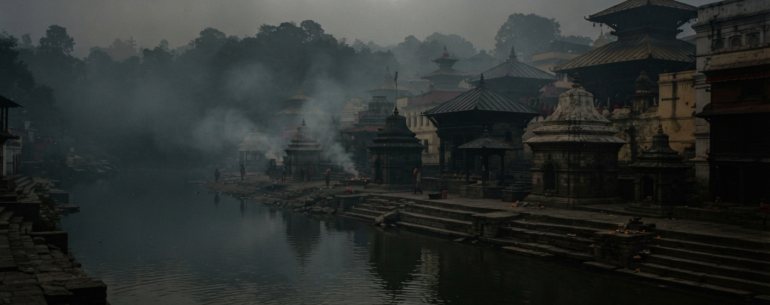

A traveller asks strange questions at Pashupatinath. Sometimes they are practical. Sometimes they are embarrassing. Sometimes they sound simple until you try to answer them.
We have never found a satisfactory answer. So we keep going, not simply visiting.
“Why are there monkeys?”
Because Shiva is worshipped here as Pashupati — a name that has meant many things to many traditions across many centuries, but which travellers usually translate, correctly enough for now, as something like “Lord of Animals.” Walk through the complex and the name stops sounding like an abstraction. Monkeys on the shrines. Dogs asleep on the steps. Birds in the roofs. Humans and animals occupying the same sacred ground.
We’ll come back to that name. It gets stranger the longer you sit with it.
“Why is the stone shaped like that?”
You’ll be shown it before anyone explains it. That’s deliberate.
It’s called a linga. It isn’t a portrait — it doesn’t attempt to make the infinite look like a man. Later, we’ll go into what it’s actually pointing toward. For now, just notice the shape, and notice what your own mind does with it before anyone tells you what to think.
“Why can’t I go inside?”
The main sanctum is reserved for Hindus. That’s simply true, and we won’t dress it up as anything other than what it is. It isn’t ours to open, and pretending otherwise would be a kind of theft. What we can do is help you understand what lies within, and stand with you at the threshold.
That’s where most tours stop. Ours doesn’t, because the traveller who asked about monkeys and stone usually ends up asking something else before the morning is over.
“Is Shiva a person?”
Sometimes.
At least, there are stories in which he behaves like one. He wanders, marries, fights, meditates, disappears into forests, appears as a beggar, becomes furious, falls in love. He has a body, a family, a mount, names by the hundred.
In others, Shiva is the supreme reality. In others still, Shiva is consciousness itself — not something sitting inside the universe, but the very awareness through which a universe can appear.
So perhaps we have asked the wrong question. Perhaps the question is not whether Shiva is a person, but what a person is.
This morning, you woke.
For a moment, before the names and plans and unfinished thoughts returned, there was simply knowing: the room, the light, the fact of being awake.
Then the story of you began again.
Your name. Your history. Your plans. Your troubles.
But what was there before the story?
What was it that knew?
“So is Shiva consciousness?”
Some Shaiva philosophers would come close to saying exactly that. But say it plainly and you’ve already made a new concept to hide behind — swapped one name for another.
So ask again: what is consciousness?
Notice what happens when you try to answer with “the brain.” You are already aware of a brain as an object of thought. You can study it, image it, place it under a microscope. But what is the thing in which the image, the thought, the microscope, and the question all appear? That doesn’t prove consciousness exists apart from the brain. It proves something more modest: you cannot get outside awareness to inspect awareness from the outside.
“Then am I God?”
Depends what you mean by “I.”
Your name, memories, profession, face, childhood, ambitions — probably not. Those change. The child you were is gone. Your body, thoughts, moods, opinions, even your idea of yourself — all changing. And yet, somehow, through all of it: I am.
“Then the world is illusion?”
Some Vedantins would say something close to that. Classical Advaita holds that Brahman alone is finally real, and what we call the world — multiplicity, change, “you” and “me” as separate things — is maya: not nothing, but not what it appears to be either. A rope mistaken for a snake in poor light.
“But the Shaivas don’t say that?”
Not in the same way. For the non-dual Shaivas of Kashmir, the world isn’t a mistake standing outside consciousness waiting to be seen through. It’s consciousness taking form — Shakti, the dynamic power by which the one becomes many, the still becomes movement. Manifestation isn’t the veil. It’s closer to the point.
That’s not a small disagreement, and we won’t pretend it is. Two of the deepest minds India has produced looked at the same world and reached genuinely different conclusions about what it is. You’re allowed to find that unsettled rather than resolved.
“Then why don’t I feel divine?”
Because you’re busy feeling like yourself. Remembering yesterday, planning tomorrow, defending an opinion, wanting something, fearing something, calling yourself successful or unsuccessful, spiritual or unspiritual.
The problem may not be that the divine is absent. It may be that almost everything you experience has already been given a name — and a name can become a wall.
“Then what is this?”
The traveller points again to the stone from the beginning of the morning.
We could answer with history, iconography, mythology. All useful. None of it finishes the question. A linga gives the mind a form and then asks the mind to notice the limits of form. What does a shape mean when it’s pointing beyond every shape?
What if the stone isn’t the point?
Why do you look at a photograph of someone you love? The paper isn’t the person — you know that — and yet it isn’t nothing either. The same object can be ordinary to one person and sacred to another, not because the object changed, but because attention did. That may be one of the oldest things a temple teaches: the object is fixed. The gaze isn’t.
“So is God in the stone?”
Where is God not?
If God is somewhere in particular, God has a boundary. If God has a boundary, something exists outside God. Then “God” is no longer the absolute. So perhaps the question is malformed — you’re asking where the limitless is located.
“Then why come to a temple at all?”
Because human beings forget. Because abstraction is difficult, and eternity is hard to contemplate while answering emails. Because we need forms — a bell, a flame, a river, a stone. Something you can stand before, that can outlast you, that doesn’t need your opinion.
Pashupatinath is remarkable not merely because it’s old, but because worship has continued here as a living practice for centuries, not a preserved one. Perhaps a temple is an agreement between generations: we will keep this place long enough for you to ask your own questions here.
“You said Pashupati means Lord of Animals. What did you mean, back with the monkeys?”
The Pāśupata tradition — one of the oldest organized schools of Shaiva thought — built its philosophy around a relationship: pashu, the bound being, and Pati, the Lord who frees. It’s a philosophical move the tradition makes with the word, not a literal dictionary entry. But the move is real, and it’s worth taking seriously.
It makes the question personal. What in you is bound?
A desire you can’t stop obeying. A fear you can’t see past. An identity you can’t put down. Perhaps bondage isn’t a chain around the body. Perhaps it’s the inability to imagine you could be otherwise.
“Then is liberation becoming someone else?”
No. That’s the trap.
If liberation means becoming a better version of yourself, you’ve built a more attractive prison. More spiritual. More disciplined. More enlightened. The ego has excellent survival instincts — it can even become an enlightened ego. The older traditions are more severe than we are. They ask: who is the one demanding liberation?
Who?
A thought appears: I want freedom.
Who knows the thought?
Another thought answers: I know the thought.
Who knows that thought?
And so you keep stepping backward, like a mirror trying to see itself. Perhaps liberation isn’t finding the final answer. Perhaps it’s discovering the question was built from a false separation in the first place. That’s close to the logic of pratyabhijñā — “recognition” — in Kashmir Shaivism. It teaches that the individual soul is fundamentally identical to the supreme divine consciousness (Śhiva). Liberation is achieved not by creating something new, but by directly recognizing one’s true divine nature.
Recognition feels like discovery and remembrance at once. What if awakening is that, pushed to the absolute? Not becoming divine, but recognizing that the consciousness you’ve been searching for was never absent.
What, exactly, have you been searching for?
“Then what is Tantra?”
Not what the internet usually means by it. Not mystical decoration, not incense and breathwork.
Tantra begins with an uncomfortable refusal: what if liberation doesn’t require escaping the world we’ve been given? What if the body, desire, fear, sound and death aren’t obstacles placed between us and reality, but precisely the material through which reality can be encountered?
What is experience, before we divide it into sacred and profane?
“Why does Shiva destroy?”
Because nothing remains. Stars die. Bodies die. Kingdoms and civilizations disappear. The river changes while you’re looking at it. You call one body “yourself,” though nearly everything about it will eventually be replaced.
Shiva’s destruction may be frightening only because we’re attached to permanence in a universe that refuses to provide it. If everything changes — what is it that knows the change?
“What is death, here?”
We can explain cremation, ritual, the river, moksha. Explanation has a limit. Eventually there’s a body on the pyre. Fire. Smoke. A family standing nearby. No philosophy makes that unreal.
That is why Pashupatinath resists being reduced to a monument. The question of death isn’t behind glass here. It’s happening. Someone is being born somewhere. Someone is making tea. Someone is praying. Someone is dying. Nothing waits for philosophy to finish speaking.
“The Vedantins say one thing. The Shaivas another. What do you say?”
We say: the Vedantins will take you one way. The Shaivas may take you another. The Tantrics will make the distinction stranger still.
And the temple will refuse to settle the argument.
Because Pashupatinath isn’t an illustration of philosophy. Philosophy arrives here and meets a place that existed before your questions and will go on existing after them.
“Then what is the centre of the universe?”
We don’t know. Maybe this valley is. Maybe it isn’t. A place can be the centre of a universe without being the centre of the universe — for a believer, because generations have oriented their lives around it. For a philosopher, the question goes elsewhere: what does “centre” mean where there’s no edge? What does “outside” mean if reality is one?
Remove every object from your idea of reality — every mountain, every god, every star, every body. What remains?
“Nothing?”
Maybe. And now we’ve reached the dangerous word.
We use “nothing” to mean absence, blankness. But what if it’s only a name for what the mind can’t turn into an object? What if you can’t stand outside reality to know it, because you’re already inside the knowing?
The old inquiries don’t always answer this with a theory. Sometimes they answer by stripping language away.
Not this.
Not this.
Not this.
Until the one asking has nowhere left to stand.
“So why go looking?”
Perhaps because searching is part of the forgetting. Perhaps because something in us suspects the life we’re living is larger than the story we’ve told about it. Perhaps the journey matters even if the destination was never elsewhere. That’s why people cross rivers. Climb mountains. Return to the same temple after their parents die. Stand before a stone before dawn.
“Where are we going?”
“Bageshwori.”
And you’re walking out.
The divine question doesn’t get resolved. The tea gets cold. The traffic continues. The guide needs to get home. The river keeps moving, the way it was moving before you arrived and will keep moving after.
That’s more honest than a revelation would have been.
And perhaps, for a moment on the walk back, something in you goes quiet enough to notice that the question was never really about the temple.
It was about the one who came looking.
Who is that?
Perhaps you don’t need another answer. Perhaps you need to go there.
Walk the Pashupatinath Journey with Cold Feet →
Guhyeshwari · Pashupatinath · Bageshwori · The Bagmati
Leave a Reply
You must be logged in to post a comment.