

How the Kumari Ghar Protects the Sacred
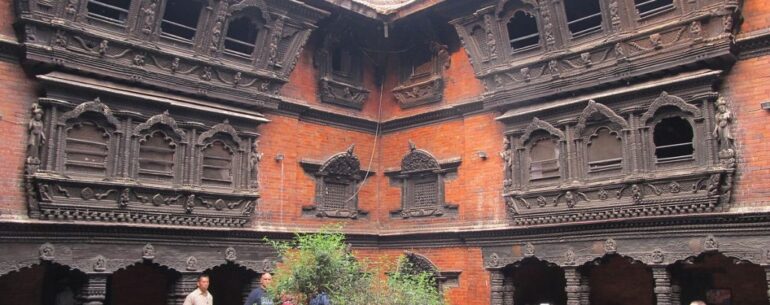
Most visitors leave the Kumari Ghar remembering its elaborate wooden windows. They photograph the dark latticework, admire the precision of the carvings, and move on, often assuming they have witnessed one of the finest surviving examples of Newari craftsmanship. What they are seeing, though, is only the surface.
The windows were never meant to be admired for their beauty alone. They were engineered to preserve the sanctity of a space inhabited by Nepal’s Living Goddess. Every carved beam, projecting lattice, and shadowed opening serves a purpose beyond ornament, transforming the façade into an active participant in the building’s religious life. In the architecture of the Kumari Ghar, beauty is not the objective. It is the consequence of function.
This relationship between architecture and ritual defines much of the Kathmandu Valley’s built heritage. Temples, monasteries, and courtyards rarely separate aesthetics from belief; structural decisions are simultaneously spiritual ones, and decorative details often carry symbolic or protective weight. The Kumari Ghar embodies this philosophy with unusual clarity. Its most photographed feature is also its most misunderstood.
To understand the building, stop thinking of its windows as places to look through. Think of them instead as carefully built boundaries between the public world of the courtyard and the secluded existence of the goddess within.
The Window as a Boundary
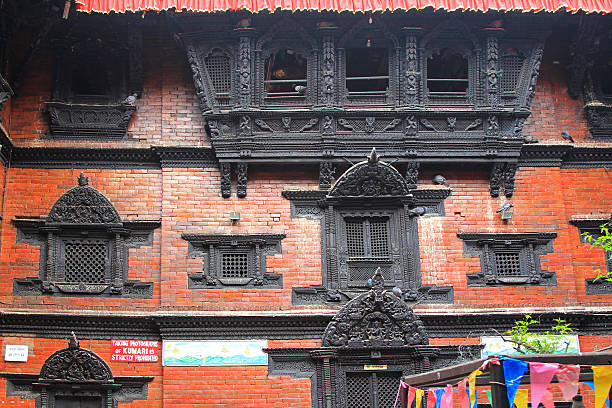
At first glance, the sanjhyā appears to do what any window does: admit light, allow air to circulate, open the interior to the world outside. Its design tells a different story. The dense wooden lattice filters daylight into soft, shifting patterns while making it remarkably difficult for anyone in the courtyard to see clearly into the rooms beyond. From within, the view outward remains surprisingly open. The result is a carefully managed asymmetry of vision — one that allows observation without exposure.
For an ordinary residence, this arrangement might simply be a matter of privacy. Inside the Kumari Ghar, privacy is inseparable from ritual. The Kumari is not merely a child living behind carved windows; she is understood as the earthly vessel of Taleju Bhawani, the tutelary goddess of the Malla kings. Her daily life, ceremonies, and appearances follow traditions that have evolved over centuries, and the architecture exists to support that seclusion. The building does not simply contain the ritual. It becomes one of its instruments.
Seen this way, the façade reads differently. What looks like an extraordinary display of craftsmanship is, in essence, a carefully engineered boundary — one that controls not only the movement of light and sight but the relationship between the sacred and the ordinary. It keeps a deliberate distance between the goddess and the public, so that her appearances remain exceptional rather than commonplace. The window is not simply an opening. It regulates presence itself.
Carving Protection into Timber
Once the window is understood this way, the carvings begin to read differently too. The floral patterns, mythical creatures, and dense geometric forms are not simply decorative flourishes added by skilled craftsmen. Together, they form a visual language through which Newari architecture expresses protection, order, and devotion — a façade that functions almost as a text written in timber.
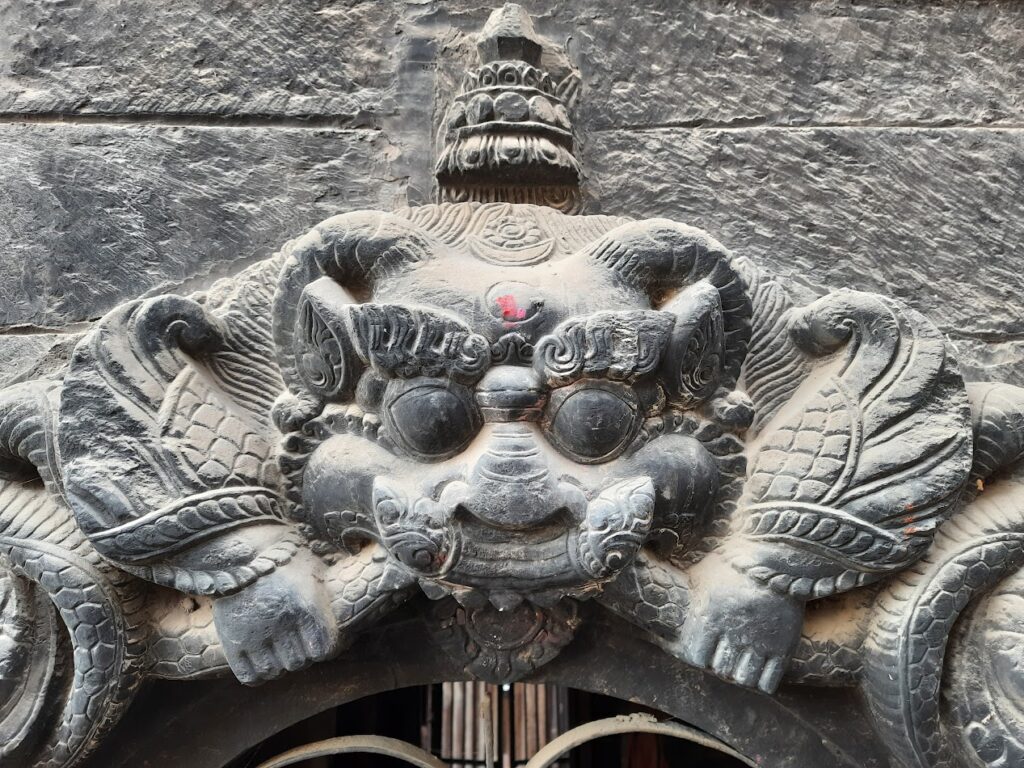
Among the figures that emerge from the carved wood is Chepu, a protective deity deeply rooted in Newar tradition and often found crowning doors, windows, and temple façades throughout the Valley. With bulging eyes, a wide mouth, and expressive features, Chepu is easily mistaken for the pan-Hindu Kirtimukha, but occupies a distinct place in Newar iconography — traditionally shown devouring serpents, an image symbolizing the triumph of protective forces over chaos. Positioned above the Kumari’s windows, Chepu marks the threshold of a sacred space, a reminder that architecture in the Valley was often entrusted with responsibilities extending far beyond structure and decoration.
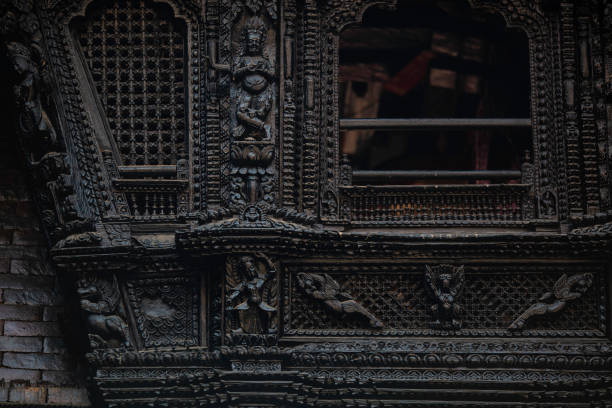
Elsewhere, serpentine forms associated with the Nāgas emerge from the timber. In the cosmology of the Valley, Nāgas guard water, fertility, and the stability of the land itself. Their presence in the woodwork reflects an enduring belief that buildings, like living beings, need both physical and spiritual protection — that a house is made secure not by engineering alone, but by its place within a broader cosmological order.
Even the lattice itself reflects this thinking. Its repeating geometry is often admired for the precision with which it filters light, but repetition has long been central to sacred art across South Asia. Whether read symbolically or simply experienced, the effect is much the same: harsh sunlight is softened, visual distraction is reduced, and the passage between the public courtyard and the private interior becomes gradual rather than abrupt.
Taken together, these carvings point to something important about Newari architecture: the artisan was not decorating a building after it was built. The carving was part of the architecture itself, inseparable from the religious purpose the building was meant to serve. Beauty emerged from that integration, not from ornament for its own sake.
A Building That Still Performs Its Duty
Built in 1757 by King Jaya Prakash Malla — the last Malla ruler of Kathmandu — the Kumari Ghar is easy to mistake for a monument preserved from another age, admired for its craftsmanship the way one might admire an old palace or a museum. That reading misses the building’s most important quality: it still performs the role it was built for. The carved windows are not surviving relics of a forgotten tradition. They remain active components of a living religious practice, one that draws Hindu and Buddhist devotees alike — the Kumari is worshipped by both communities, venerated as Taleju by Hindus and as Kumari-Tara by Buddhists, a rare point where the Valley’s two dominant faiths meet under one roof.
This continuity defines much of the Kathmandu Valley’s heritage. Unlike many historic monuments elsewhere, the Valley’s temples were never preserved simply because they were old. They survived because generations kept using them. Daily worship, seasonal festivals — most visibly Indra Jatra each autumn, when the Kumari is carried through the old city in a wooden chariot — and community ritual keep these spaces woven into the rhythm of contemporary life. Their value lies not only in their age but in their uninterrupted function.
The Kumari Ghar carries this forward with particular clarity. Generations of Newari artisans have repaired damaged carvings, replaced weathered timber, and maintained the building through the traditional Guthi system — not as an exercise in conservation, but as an act of religious and civic responsibility. The darkened wood visible today bears the marks of this care. Layers of age, incense, dust, oil, and countless monsoon seasons haven’t diminished the building’s significance. They have become part of its history, recording centuries of devotion in the surface of the timber itself.
This is worth remembering the next time you’re standing in that courtyard, camera raised at the latticework above. The craftsmanship is real, and it deserves the attention it gets. But the finest achievement of the Kumari Ghar isn’t what it puts on display for the crowd below. It’s the small, unlit room somewhere behind that lattice — a room most visitors will never see, holding a life the architecture was built entirely to protect.

Leave a Reply
You must be logged in to post a comment.