
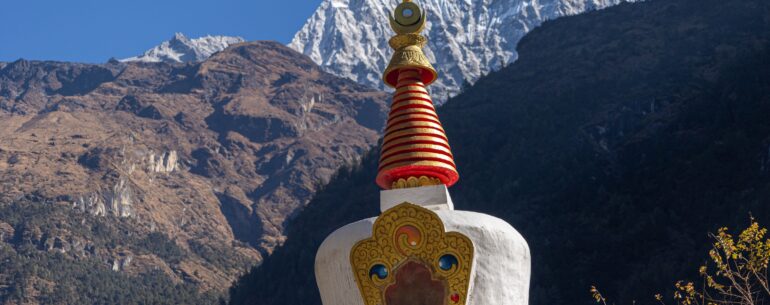

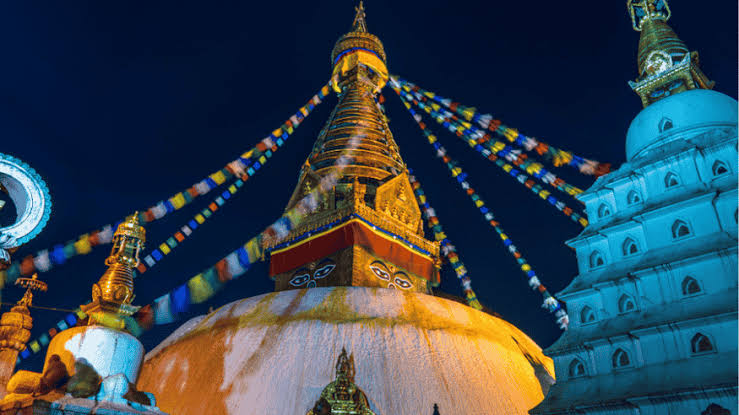
Ask someone to draw a Buddhist stupa and you’ll get a white dome, a pair of eyes, a golden spire. Recognizable, and almost entirely unread — because a stupa isn’t built to be looked at. It’s built to be read, level by level, like a diagram of the path to enlightenment.
The base
At Boudhanath, the monument doesn’t rise straight from the ground — it sits on broad, stepped terraces that most visitors walk past without climbing onto. In Vajrayana Buddhist symbolism, this level corresponds to earth: stability, patience, the ground every later stage depends on. It’s also where kora happens — the practice of walking clockwise around the stupa — which reads less like a scenic lap and more like a slow, repeated act of attention.
The dome
The great white dome is called the kumbha — vessel, or pot — and corresponds to water. It has no corners; the eye just follows the curve back to where it started, which is part of the point. At Swayambhunath specifically, the dome sits on a hill that, by local legend, rose out of an ancient lake once said to have filled the Kathmandu Valley — architecture and origin story lining up.
The eyes, and the thing everyone gets wrong
Above the dome sits the harmikā, the small square tower carrying the Buddha’s eyes — the single most photographed detail on either monument. Most visitors call the curved mark beneath the eyes a nose. It isn’t. It’s the Nepali numeral १ — “ek,” one — representing the idea that Buddhism’s many paths converge on a single truth. Above the eyes, a smaller mark, the ūrṇā, represents insight beyond ordinary sight.
The spire
Above the harmikā, the tiered gilded spire has exactly thirteen rings — the trayodasa bhūmi, the traditional thirteen stages a bodhisattva moves through toward full enlightenment. At the summit sits a gilded finial representing space, or ether — the point where all the earlier elements dissolve.
If you go
At Boudhanath, most visitors stay on the outer commercial ring and never actually enter the monument — but you can, through the northern gateway, and walk the stepped terraces themselves rather than just around them. At Swayambhunath, the eastern approach has exactly 365 stone steps, one for each day of the year, built under King Pratap Malla in the 17th century; foreign visitors pay an entrance fee at the base. Go early — before 8am, ideally — when the crowds are thinner and monks are still doing morning kora. Once you’re there: look for the numeral beneath the eyes before anyone tells you it’s not a nose.
Leave a Reply
You must be logged in to post a comment.