
Skip to content
  • MAIN SITE
  • ABOUT
    • Why Coldfeet
    • Our Team
    • Message From MD
  • Destination
    • Nepal
    • India
    • Bhutan
    • Tibet
  • Activities
  • Gallery
  • Contact
Menu
Cold Feet Adventure
  • MAIN SITE
  • ABOUT
    • Why Coldfeet
    • Our Team
    • Message From MD
  • Destination
    • Nepal
    • India
    • Bhutan
    • Tibet
  • Activities
  • Gallery
  • Contact
Home/Reading a Stupa: What Boudhanath and Swayambhunath Are Actually Saying
Posted inSat Ghumti Adventure Alley

Reading a Stupa: What Boudhanath and Swayambhunath Are Actually Saying

Posted By Cold Feet Adventure Posted on August 13, 2026
0

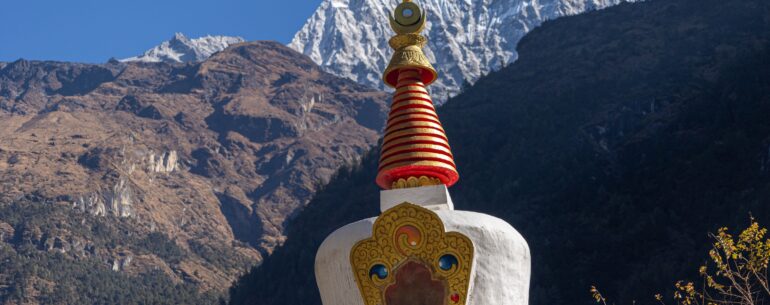
Ask someone to draw a Buddhist stupa and you’ll get a white dome, a pair of eyes, a golden spire. Recognizable, and almost entirely unread — because a stupa isn’t built to be looked at. It’s built to be read, level by level, like a diagram of the path to enlightenment.

The base

At Boudhanath, the monument doesn’t rise straight from the ground — it sits on broad, stepped terraces that most visitors walk past without climbing onto. In Vajrayana Buddhist symbolism, this level corresponds to earth: stability, patience, the ground every later stage depends on. It’s also where kora happens — the practice of walking clockwise around the stupa — which reads less like a scenic lap and more like a slow, repeated act of attention.

The dome

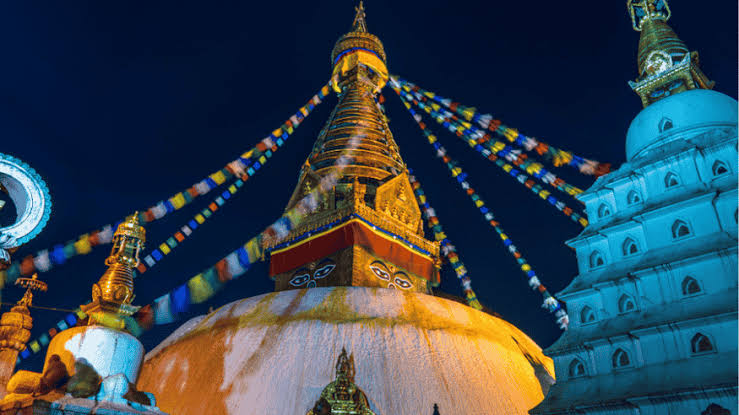
The great white dome is called the kumbha — vessel, or pot — and corresponds to water. It has no corners; the eye just follows the curve back to where it started, which is part of the point. At Swayambhunath specifically, the dome sits on a hill that, by local legend, rose out of an ancient lake once said to have filled the Kathmandu Valley — architecture and origin story lining up.

The eyes, and the thing everyone gets wrong

Above the dome sits the harmikā, the small square tower carrying the Buddha’s eyes — the single most photographed detail on either monument. Most visitors call the curved mark beneath the eyes a nose. It isn’t. It’s the Nepali numeral १ — “ek,” one — representing the idea that Buddhism’s many paths converge on a single truth. Above the eyes, a smaller mark, the ūrṇā, represents insight beyond ordinary sight.

The spire

Above the harmikā, the tiered gilded spire has exactly thirteen rings — the trayodasa bhūmi, the traditional thirteen stages a bodhisattva moves through toward full enlightenment. At the summit sits a gilded finial representing space, or ether — the point where all the earlier elements dissolve.

If you go

At Boudhanath, most visitors stay on the outer commercial ring and never actually enter the monument — but you can, through the northern gateway, and walk the stepped terraces themselves rather than just around them. At Swayambhunath, the eastern approach has exactly 365 stone steps, one for each day of the year, built under King Pratap Malla in the 17th century; foreign visitors pay an entrance fee at the base. Go early — before 8am, ideally — when the crowds are thinner and monks are still doing morning kora. Once you’re there: look for the numeral beneath the eyes before anyone tells you it’s not a nose.

Previous Article Remote Trekking in Nepal: 5 Off-Grid Treks for a Digital Detox
Next Article Why Every Hindu Should Visit Pashupatinath Once

Leave a Reply

Cancel reply

You must be logged in to post a comment.

Related Posts

Posted inSat Ghumti Adventure Alley

Why Every Hindu Should Visit Pashupatinath Once

On the banks of the Bagmati River stands one of the most revered Shiva temples in the Hindu world. Here, Lord Shiva is worshipped as Pashupati, the Lord of All Living Beings. Worship begins before sunrise and continues late into

Read More about Why Every Hindu Should Visit Pashupatinath Once
Posted By Cold Feet Adventure Posted on August 13, 2026
0
Posted inSat Ghumti Adventure Alley

Nepal Beyond Everest: 7 Treks for People Who Don’t Want the Crowds

Everyone knows Everest. For many people planning their first trip to Nepal, the name almost decides the trek before they have looked at a map. Everest Base Camp is an extraordinary journey, and there is a good reason it has

Read More about Nepal Beyond Everest: 7 Treks for People Who Don’t Want the Crowds
Posted By Cold Feet Adventure Posted on August 13, 2026
0

Recent Posts

  • The Questions We Take to Pashupatinath | Shiva & Consciousness
  • Nepal Beyond Everest: 7 Treks for People Who Don’t Want the Crowds
  • Why Every Hindu Should Visit Pashupatinath Once
  • Reading a Stupa: What Boudhanath and Swayambhunath Are Actually Saying
  • Remote Trekking in Nepal: 5 Off-Grid Treks for a Digital Detox

Recent Comments

No comments to show.

Archives

  • August 2026
  • July 2026
  • May 2026
  • October 2019
  • July 2019
  • January 2018
  • December 2017
  • November 2017
  • October 2017
  • September 2017
  • August 2017
  • July 2017
  • June 2017
  • May 2017
  • March 2017
  • February 2017
  • December 2016
  • November 2016
  • September 2016
  • August 2016
  • July 2016
  • June 2016
  • May 2016
  • April 2016
  • March 2016
  • February 2016
  • January 2016
  • November 2015
  • September 2015
  • August 2015
  • July 2015
  • May 2015
  • March 2015
  • February 2015
  • January 2015
  • December 2014
  • November 2014
  • October 2014
  • September 2014
  • August 2014
  • March 2014
  • February 2014
  • January 2014
  • December 2013
  • November 2013
  • October 2013
  • June 2013
  • May 2013

Categories

  • ? Culture & Heritage
  • Canyoning
  • Color Festival
  • Cultural Treks
  • Entertainment
  • Festival
  • Festival in Nepal
  • Heli Tours
  • Hiking
  • Mountain Climbing
  • Nepal News
  • Peak Climbing
  • Sat Ghumti Adventure Alley
  • Shivaratri
  • Spiritual Travel
  • Teej Festival Women's
  • Tours
  • travel agency
  • Travel Management
  • Trekking
© 2026 Cold Feet Adventure Nepal Trekking Pvt. Ltd. Developed by: Digixel Inc

Powered by
►
Necessary cookies enable essential site features like secure log-ins and consent preference adjustments. They do not store personal data.
None
►
Functional cookies support features like content sharing on social media, collecting feedback, and enabling third-party tools.
None
►
Analytical cookies track visitor interactions, providing insights on metrics like visitor count, bounce rate, and traffic sources.
None
►
Advertisement cookies deliver personalized ads based on your previous visits and analyze the effectiveness of ad campaigns.
None
►
Unclassified cookies are cookies that we are in the process of classifying, together with the providers of individual cookies.
None
Powered by