
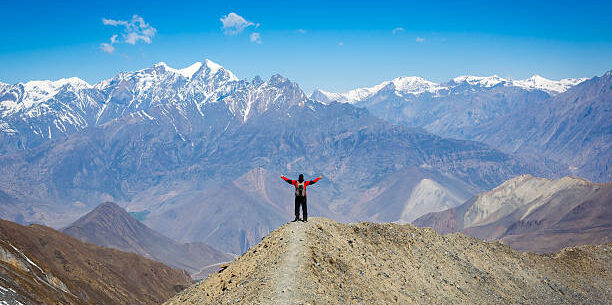

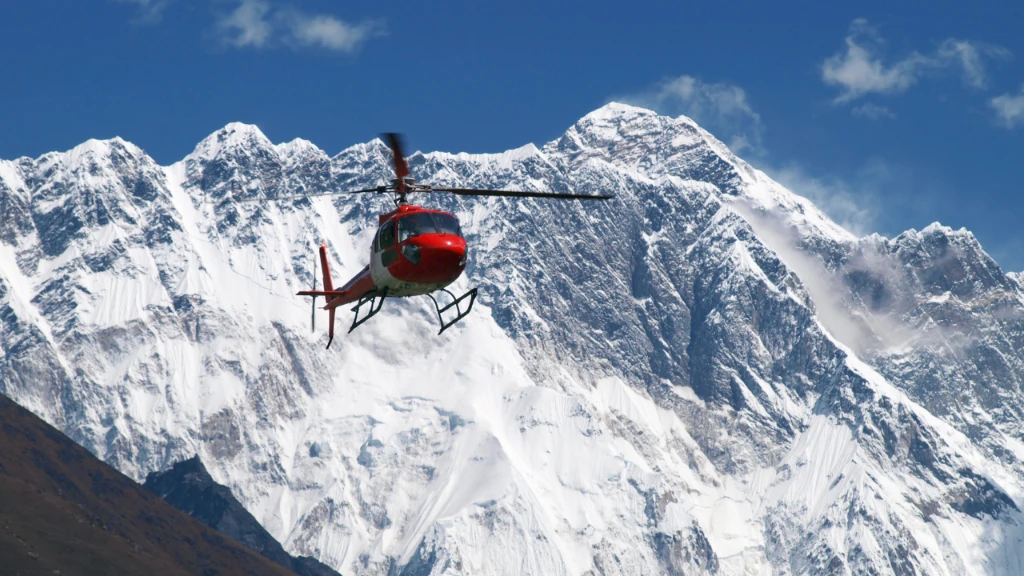
At 5,000 metres, walking uphill can leave you out of breath after twenty steps. Not because you’re unfit, and not because there is suddenly less oxygen in the air — there isn’t. What has changed is the air pressure, and therefore the amount of oxygen available to your body with each breath.
This is the part that confuses many first-time trekkers. The air at Everest Base Camp is still roughly 21% oxygen, just as it is at sea level. But atmospheric pressure is much lower, so each breath delivers less oxygen to your bloodstream. Your body notices almost immediately. You breathe faster. Your heart works harder. Sleep can change. Appetite can change. None of this necessarily means something is wrong. It means your body is responding to a different environment.
Understanding that response, and giving your body time to adapt, is one of the most important parts of trekking at altitude. This guide looks at what actually happens inside your body above 5,000 metres, why fitness alone cannot protect you from altitude sickness, and what acclimatization really means on a trek in Nepal.
If you remember only five things
- Altitude sickness can affect anyone, regardless of fitness or experience.
- Fitness helps you walk. It does not help you acclimatize.
- Ascend gradually and give your body time — that’s what acclimatization days are for.
- Don’t continue ascending if symptoms are getting worse.
- Confusion, loss of coordination or breathlessness at rest mean immediate descent and medical attention.
How High Is 5,000 Metres?
Five thousand metres is about 16,400 feet — already well into what’s considered extreme altitude, not just “high altitude.” To put the numbers from this guide in context:
- Namche Bazaar: 3,440 m / 11,286 ft
- Everest Base Camp: 5,364 m / 17,598 ft
- Kala Patthar: 5,545 m / 18,192 ft
Most people never spend extended time above 3,000 metres in daily life. On a classic Everest region trek, you’re living and sleeping above that line for well over a week — which is exactly why acclimatization becomes the central design principle of the whole itinerary, not an afterthought.
What Is Altitude Sickness?
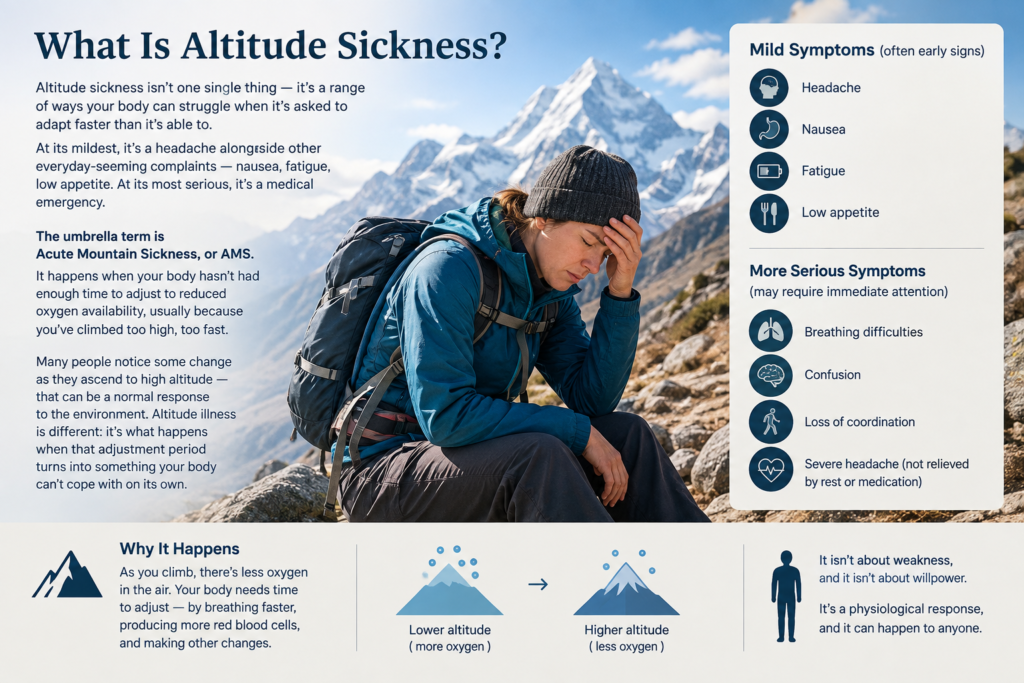
Altitude sickness isn’t one single thing — it’s a range of ways your body can struggle when it’s asked to adapt faster than it’s able to. At its mildest, it’s a headache alongside other everyday-seeming complaints — nausea, fatigue, low appetite. At its most serious, it’s a medical emergency.
The umbrella term is Acute Mountain Sickness, or AMS. It happens when your body hasn’t had enough time to adjust to reduced oxygen availability, usually because you’ve climbed too high, too fast. Many people notice some change as they ascend to high altitude — that can be a normal response to the environment. Altitude illness is different: it’s what happens when that adjustment period turns into something your body can’t cope with on its own.
It isn’t about weakness, and it isn’t about willpower. It’s a physiological response, and it can happen to anyone — a detail worth sitting with before we get to the specifics, since it’s the most misunderstood part of the whole subject.
Acclimatization: Giving the Body Time
There is no shortcut around acclimatization.
Your body needs time to respond to the lower availability of oxygen, and the higher you climb, the less margin there is to skip it. A well-planned trek treats acclimatization as part of the journey rather than an interruption to it.
This is why Nepal trekking itineraries often include days where you appear to go nowhere.
You might spend a night or two in a village such as Namche Bazaar, then climb higher during the day before returning to sleep at the same elevation. The itinerary may look slower on paper. Your body, however, is using that time to make the adjustments that allow you to continue safely.
What Your Body Is Doing During Acclimatization
Acclimatization begins with changes you can feel — breathing more deeply and more frequently, your heart working harder. Over time, your body becomes more efficient at getting oxygen where it needs to go.
The kidneys help too, adjusting your blood chemistry so that faster breathing can be sustained. Over several days, the body makes further adaptations that improve oxygen delivery and use.
You don’t need to consciously do anything to make most of these changes happen. Your job is largely to give them time. That is why the pace of ascent matters so much.
How Long Does It Take to Acclimatize?
There’s no single number that applies to everyone, but there is a useful working rule.
Initial acclimatization begins within hours of gaining altitude, but the fuller process takes several days — and at any fixed altitude, that adaptation is never fully complete. The general guidance from health authorities such as the CDC is that once you’re above roughly 3,000 metres, your sleeping altitude shouldn’t increase by more than about 500 metres a night, with an extra acclimatization day built in for every additional 1,000 metres of sleeping-altitude gain.
That’s guidance, not a guarantee — individual response to altitude varies considerably, which is exactly why a flexible itinerary matters more than a fast one.
Why Going Slowly Matters
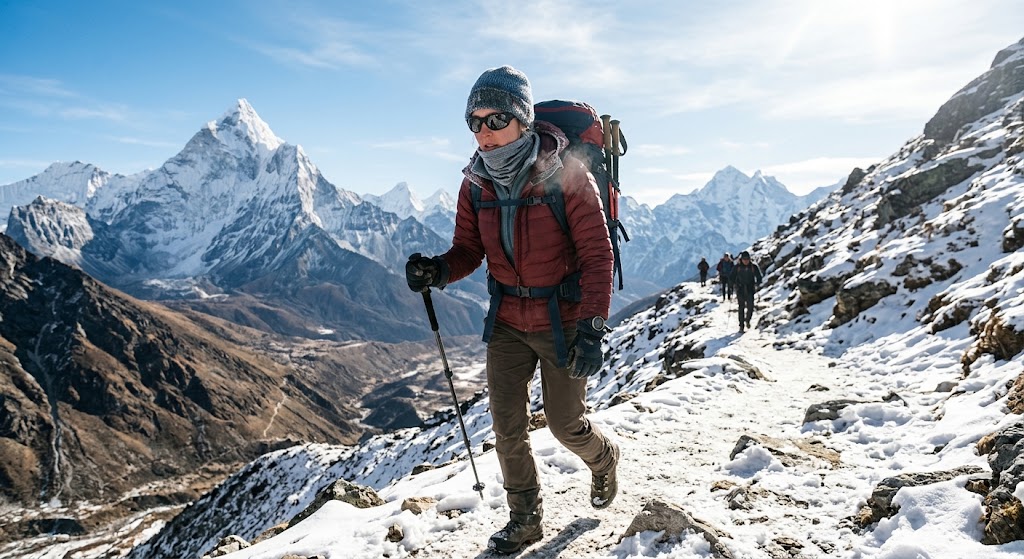
Skip the acclimatization days, and it’s easy to gain altitude faster than your body can adjust to. Your legs might be ready to walk farther before the rest of your body is ready to sleep higher.
A good itinerary accounts for that gap — building elevation gradually, including acclimatization days, and not treating every kilometre on the map as something to cover immediately. This becomes particularly important above roughly 3,000 metres, where the rate at which you gain sleeping altitude matters more with every step up.
Acclimatization Is Not a Guarantee
Even a carefully planned ascent does not make altitude sickness impossible.
People acclimatize at different rates, and previous success at altitude does not guarantee you’ll respond the same way on another trek. Weather, illness, fatigue and the pace of ascent can all affect how you feel — which is also part of why choosing the right season for your trek matters.
Acclimatization reduces the risk. It does not remove it.
That distinction matters, because it changes how you should think about the days when you are not gaining altitude. An acclimatization day isn’t there because your itinerary needs a break. It is there because your body does.
What About Medication? Diamox and Other Options
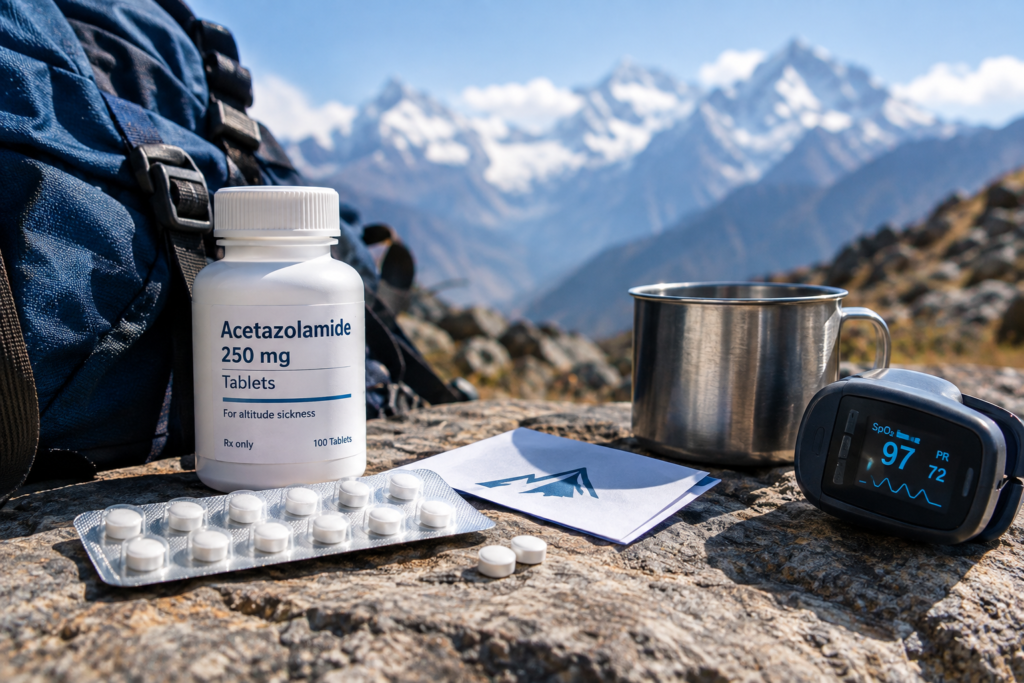
Acclimatization is the foundation, but it isn’t the only tool available. Many trekkers also ask about medication — most often acetazolamide, sold as Diamox.
Acetazolamide doesn’t replace acclimatization. What it does is nudge your body’s own adjustment process along, by changing your blood chemistry in a way that encourages you to breathe more — something close to what happens naturally over several days at altitude anyway. Some trekkers use it preventively, starting before they reach altitude; others only if mild symptoms appear. Either way, it needs a doctor’s guidance rather than a group-chat recommendation. Whether it’s appropriate for you, and at what dose, depends on your own health history — sulfa allergy is one of the things worth raising with a doctor specifically, though current guidance suggests the actual reaction risk from acetazolamide is low even in that group.
It’s also worth knowing what it doesn’t do. Diamox won’t let you skip acclimatization days safely, and it won’t stop HACE or HAPE once they’ve started — those require descent, not a tablet. Other medications, like dexamethasone, exist specifically for emergency treatment of severe altitude illness, administered under medical supervision — not something to self-administer “just in case.”
The honest takeaway: talk to a doctor before your trek, not during it. If medication is right for you, work out the details in advance. Altitude is not the place to start experimenting with something new.
Does Being Fit Protect You From Altitude Sickness?
This might be the most misunderstood part of trekking at altitude.
Fitness helps you walk. It doesn’t help you adjust to thinner air — those are two different things, and the mountain doesn’t reward one for the other. A trained runner, someone who can comfortably do a marathon at sea level, can still develop altitude sickness on day two of a trek. Someone far less fit, moving more slowly and taking more rest, can acclimatize without much trouble at all.
That’s not a contradiction. It’s the point.
Altitude sickness isn’t caused by exertion — it’s caused by ascending faster than your body can adapt. A strong cardiovascular system makes climbing easier on your legs and lungs in the moment. It has very little to do with how quickly your body can adjust to reduced oxygen over days, which is a separate, slower physiological process that fitness doesn’t speed up.
If anything, fitness can work against you here. Strong trekkers sometimes move faster than their itinerary intends, covering more ground than planned and gaining altitude ahead of schedule — the exact pattern that makes acclimatization harder, not easier.
No. Physical fitness does not prevent altitude sickness. Anyone ascending to high altitude can be affected, regardless of age, fitness or prior trekking experience.
What actually matters is pace, previous exposure to altitude, and how well you listen to your body along the way — not how many kilometres you can run at home.
Altitude Sickness Symptoms: What Mild AMS Feels Like
The first signs of altitude sickness are often easy to dismiss.
You have walked for several hours. You are tired. Perhaps you have a headache. At 4,000 metres, it is tempting to blame all of this on the cold, the long day, the unfamiliar bed or simply the fact that you are trekking.
Sometimes that is exactly what it is.
But altitude sickness has a pattern worth knowing. The most common symptoms of Acute Mountain Sickness include headache, nausea, dizziness, unusual fatigue and loss of appetite. Sleep can be disturbed too, though current clinical guidance treats headache as the more reliable signal — a rough night alone, without headache or the other symptoms, is less meaningful on its own. These symptoms typically develop after gaining altitude and may become more noticeable during the first hours or day after arriving higher.
A headache alone does not automatically mean you have AMS. What matters is the combination of symptoms, the timing of their appearance, and whether they improve or worsen.
If you have recently gained altitude and begin feeling distinctly unwell, the sensible response is not to ignore it simply because everyone else seems fine.
Tell someone. Your guide, trekking partner or another member of your group may notice changes that you have become too tired to recognize yourself.
Normal at Altitude vs. Warning Sign
| What you notice | May be normal at altitude | More concerning |
|---|---|---|
| Breathing | Heavier breathing while walking | Breathlessness at rest |
| Tiredness | After a long walking day | Severe or unusual exhaustion |
| Headache | Mild, especially after exertion | Persistent or worsening, with other symptoms |
| Sleep | Disturbed sleep | Sleep disturbance alongside worsening illness |
| Walking | Slower pace | Difficulty walking or loss of coordination |
| Mental state | Tired but alert | Confusion or unusual behaviour |
The Important Rule: Don’t Ascend With Worsening Symptoms
This is one of the simplest rules in high-altitude trekking.
If symptoms are getting worse, do not continue ascending.
Resting at the same altitude may be appropriate for mild symptoms while they are monitored. But if symptoms do not improve, or if they become more severe, descending becomes increasingly important.
This is where the discipline of a good itinerary matters. A planned acclimatization day gives you somewhere to stop. A flexible guide can change the day’s plan. A trekker who has built an extra day into the itinerary has more options than someone racing toward a fixed destination.
At altitude, flexibility is not inefficiency. It is safety.
When Altitude Sickness Becomes Serious
Most cases of AMS are mild, but altitude illness can progress into two rare and potentially fatal conditions: High-Altitude Cerebral Edema (HACE) and High-Altitude Pulmonary Edema (HAPE).
These are medical emergencies.
High-Altitude Cerebral Edema
HACE involves swelling of the brain and is generally considered a severe progression of altitude illness.
The warning signs go beyond an ordinary headache or tiredness. Confusion, severe difficulty walking or maintaining coordination, unusual behavior, extreme drowsiness or a reduced level of consciousness are reasons for immediate action.
A person who is struggling to walk in a way that is clearly different from normal fatigue should not simply be told to rest and try again in the morning.
The response is immediate descent and urgent medical care.
High-Altitude Pulmonary Edema
HAPE affects the lungs.
Early symptoms can include unusual breathlessness, particularly at rest, a persistent cough, marked weakness and a feeling of tightness or difficulty breathing. As it progresses, breathing can become severely impaired.
Again, this is not something to wait out. Immediate descent and urgent medical attention are essential.
The distinction between normal exertion and a medical emergency can sometimes be difficult for an inexperienced trekker to make. That is one reason guides matter in high-altitude environments. Someone who knows the route and has experience with altitude can help assess a changing situation and make a decision before it becomes critical.
The mountain does not become safer because the next village is only two hours away.
Sometimes the correct direction is down.
What Should You Do If You Develop Symptoms?
The steps here are simple, even if they’re not always easy to follow in the moment.
Don’t keep ascending. If you have symptoms and they’re getting worse, going higher is the one thing that reliably makes things worse. This holds even if the next stop is close, even if the group is moving on, even if you feel like you should be able to push through.
Tell your guide or a trekking partner. Altitude can affect judgment before it affects anything else, which means the person best placed to notice a problem is often not you. Saying something early costs you very little. Saying nothing can cost you the option to descend safely later.
Rest and monitor how you feel. For mild symptoms, staying at the same altitude — not higher, not necessarily lower — and watching whether things improve or worsen is often the right first step. This is what acclimatization days are built for.
Descend if symptoms worsen. If rest doesn’t help, or symptoms continue to progress, descending is not a last resort. It is the treatment. Every additional metre of altitude asks more of a body that is already struggling to keep up.
Seek medical help for anything serious. Confusion, severe breathlessness at rest, an inability to walk normally — these are not symptoms to monitor overnight. They call for immediate descent and medical attention, without waiting to see if things improve on their own.
None of this requires expert judgment. It requires being honest about what you’re feeling, and being willing to act on it before it becomes urgent.
How a Good Trekking Itinerary Helps You Acclimatize
Altitude management begins long before you feel the first headache.
The most effective thing a trekking itinerary can do is give your body time. That sounds simple, but it shapes almost every decision along the route: how quickly you gain elevation, where you sleep, when you stop, and whether an extra day is treated as necessary or inconvenient. A well-designed itinerary doesn’t try to get you to the highest point as quickly as possible — it gives you a gradual progression toward it.
The Importance of Sleeping Altitude
One of the most useful numbers on a trekking itinerary isn’t the day’s highest point. It’s the altitude at which you’ll sleep.
You may climb considerably higher during the day and return to a lower village in the afternoon. This kind of acclimatization hike exposes your body to higher elevation without immediately asking it to spend the whole night there — a distinction that matters more and more once you’re above 3,000 metres.
Why Acclimatization Days Can Feel Strange
To someone looking at a map, an acclimatization day can look inefficient — you’ve travelled all the way to the Himalaya, and the itinerary tells you to stay another night in the same village. But the trek isn’t measured only by how far your feet travel. While you’re eating breakfast, walking to a viewpoint or sitting in a lodge, your body is adapting to its surroundings, developing the changes it needs before you sleep higher.
This is why removing acclimatization days to shorten a trek isn’t simply removing a rest day. You’re removing time your body was supposed to have — one reason it’s worth being cautious about heavily compressed itineraries built mainly to save money or days.
The Pace Matters More as You Climb
At lower elevations, you can often compensate for a fast pace by resting when you’re tired. Higher up, that relationship changes — walking too quickly increases your body’s demand for oxygen at precisely the point when less is available.
Experienced high-altitude trekkers tend to move at a pace that can seem almost unnecessarily slow to someone coming from sea level. A steady pace that lets you keep breathing comfortably is usually more useful than alternating bursts of speed with long recovery stops. The goal is to arrive at the next village with enough left to eat, sleep and keep adapting.
Why a Flexible Itinerary Is Better Than a Fast One
No itinerary can predict exactly how an individual will respond to altitude. You can plan the ascent carefully and still have a day when someone needs more time — which is why flexibility matters.
A sensible trek leaves room to slow down, add a night at the same altitude, or change the plan when conditions require it. This is especially valuable on longer routes, where trying to recover lost time by ascending faster can create a problem that’s much harder to solve later. The best itinerary isn’t necessarily the shortest one — it’s the one that gives your body a reasonable chance to get where the route is taking it.
And in the Himalaya, sometimes the most important distance on the itinerary is the distance you don’t climb today.
The Most Important Thing to Remember About Altitude
Altitude doesn’t care how determined you are.
It doesn’t care about your training, your gear, or how much you’ve been looking forward to reaching the next village. It responds to one thing: how much time you give your body to adjust. That’s the entire logic behind everything in this guide — the slow itinerary, the acclimatization days, the rule about not ascending with worsening symptoms.
None of it is caution for its own sake. It’s what actually works.
The Mountain Is Asking for Time
At 5,000 metres, your body is doing something remarkable. It is adapting to an environment where every breath delivers less oxygen than it is used to receiving. Your breathing changes. Your heart works harder. Your sleep may become fragmented. Over several days, your body begins making the adjustments that allow you to function there.
None of this is a failure. It is the body doing its job. The important thing is to give it the time and conditions to do that properly.
That means ascending gradually, respecting acclimatization days, paying attention to symptoms and being willing to change your plans when your body tells you to. Fitness can prepare you for the walking. Experience can help you understand the mountain. But neither can replace the time your physiology needs to adapt.
This is why high-altitude trekking is not simply about reaching a number on a map. The real achievement is getting there in a way your body can handle.
The Himalaya has never been in much of a hurry. There is usually no good reason for you to be either.
Trekking at Altitude, the Cold Feet Way
Understanding altitude is one part of the picture. The other is who you’re with when you’re up there.
At Cold Feet Adventure Nepal, our itineraries are built around the same principle running through this entire guide: acclimatization isn’t a delay, it’s the plan. If you’re planning a trek to Everest Base Camp, Kala Patthar, or anywhere else above 4,000 metres, we’d rather talk you through a realistic itinerary than sell you a fast one.
Explore our Everest Base Camp treks →
Talk to us about planning your trek →
Altitude Sickness in Nepal: Frequently Asked Questions
What altitude causes altitude sickness? Altitude illness risk generally begins above about 2,500 metres, though it can occur lower in sensitive individuals. Symptoms usually appear within a few hours to three days of arriving at a new, higher altitude.
What are the first symptoms of altitude sickness? Headache is the most reliable early sign, often alongside nausea, dizziness, fatigue or reduced appetite. A single symptom in isolation isn’t necessarily AMS — it’s the combination and how it develops that matters.
Can fit people get altitude sickness? Yes. Fitness affects how easily you can walk and exert yourself — it has little bearing on how quickly your body adapts to reduced oxygen. Marathon runners can develop AMS; less athletic trekkers can acclimatize without difficulty.
How long does it take to acclimatize to high altitude? Initial acclimatization begins within hours, but the fuller process takes several days, and adaptation is never fully complete at any given altitude. This is why gradual ascent and built-in acclimatization days matter so much.
How can I prevent altitude sickness on an Everest Base Camp trek? Ascend gradually, keep your sleeping-altitude gain in check once above roughly 3,000 metres, use acclimatization days as intended, stay hydrated and fed, avoid alcohol early on, and pay attention to symptoms rather than pushing through them.
What altitude is Everest Base Camp? 5,364 metres (17,598 feet).
What altitude is Kala Patthar? 5,545 metres (18,192 feet), higher than Base Camp itself.
Can you get altitude sickness at 3,000 metres? It’s less common than at higher elevations, but it can happen, particularly with rapid ascent. Most itineraries treat 3,000 metres as the point where sleeping-altitude pacing starts to matter.
Does drinking water prevent altitude sickness? Staying hydrated supports how you feel generally, but it doesn’t prevent altitude sickness on its own. It isn’t a substitute for gradual ascent and acclimatization.
Should you descend if you have altitude sickness? For mild symptoms, resting at the same altitude may be enough. If symptoms worsen, or if there are any signs of HACE or HAPE, descent is the treatment — not a last resort.
Can you take medicine to prevent altitude sickness? Acetazolamide (Diamox) is used by some trekkers, either preventively or if mild symptoms appear, and can help speed acclimatization. It should be discussed with a doctor before your trek, not decided on the trail.
Medical note: This article is intended for general travel information and does not replace medical advice. If you have a medical condition, take regular medication, or are unsure whether high-altitude trekking is appropriate for you, speak with a qualified healthcare professional before travelling.
Sources & further reading: CDC Yellow Book — High-Altitude Travel & Altitude Illness; Wilderness Medical Society, 2024 Clinical Practice Guidelines for the Prevention, Diagnosis, and Treatment of Acute Altitude Illness.
Leave a Reply
You must be logged in to post a comment.